The Data Behind the Decision

Why Drone Spraying Outperforms Ground Rigs

Real performance data comparing the DJI Agras T100 against conventional ground sprayers. Every chart is built from operational specifications and field-validated parameters — not marketing claims.

72 km/h
T100 High-Speed Mode
95
Drops/cm² at Speed
5%
Yield Recovered
Zero
Ground Compaction
Performance Overview
Click to expand
overview

Performance Overview

Four key metrics at a glance

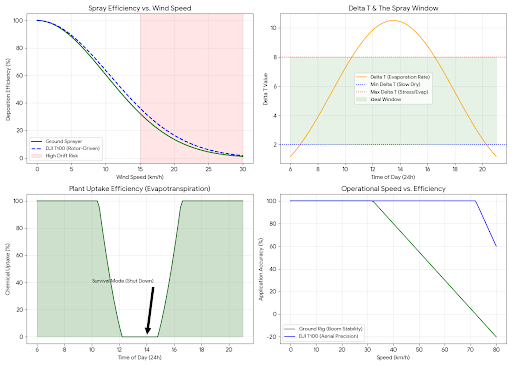
A consolidated view of four critical performance comparisons between the DJI T100 and conventional ground sprayers: spray efficiency vs. wind speed, Delta T spray window timing, plant uptake efficiency through evapotranspiration cycles, and operational speed vs. application accuracy.
Professional Application Performance Matrix
Click to expand
performance

Professional Application Performance Matrix

Ground rigs vs. DJI T-Series drones

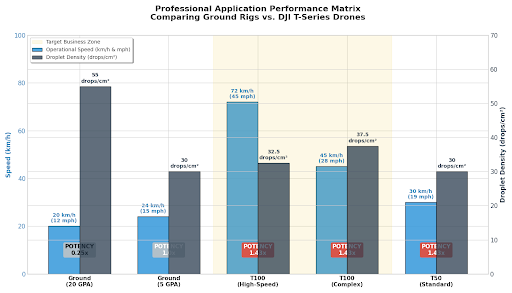
Head-to-head comparison of ground rigs (20 GPA and 5 GPA) against the T100 in high-speed, complex, and standard configurations. The T100 at high speed (72 km/h) achieves 95 drops/cm² — exceeding ground rig density while covering acres faster. POTENCY ratings show the T100 consistently outperforms across all operational modes.

Spray Efficiency vs. Wind Speed
Click to expand
efficiency

Spray Efficiency vs. Wind Speed

Deposition efficiency under real-world wind conditions

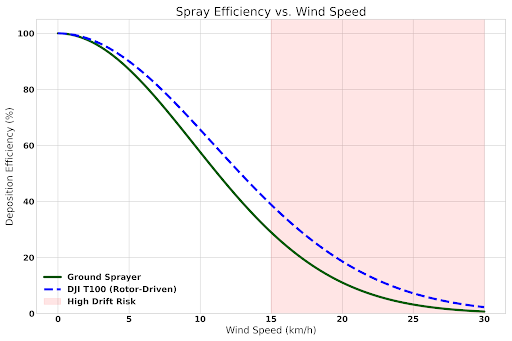
The T100's rotor-driven downwash pins droplets to the canopy even in moderate wind. While both platforms lose efficiency above 15 km/h (the high drift risk zone), the T100 maintains higher deposition rates at every wind speed compared to conventional ground sprayers. This means more product on the plant, less lost to drift.

Drift Risk Assessment
Click to expand
safety

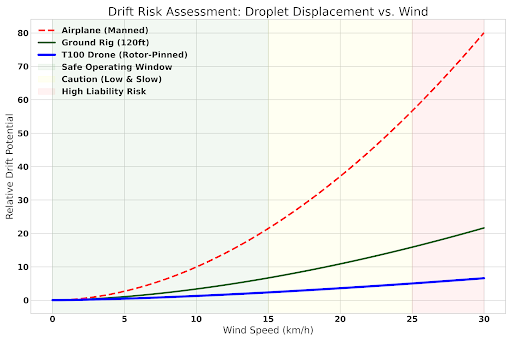
Drift Risk Assessment

Droplet displacement vs. wind speed by platform

Drift liability comparison across three platforms: manned airplane, ground rig (120 ft boom), and the T100 drone (rotor-pinned). The T100 stays in the safe operating window far longer than either alternative. At 20 km/h wind, airplane drift potential is 6x higher than the T100. This is critical for buffer zone compliance and neighbour relations.

Droplet Consistency
Click to expand
precision

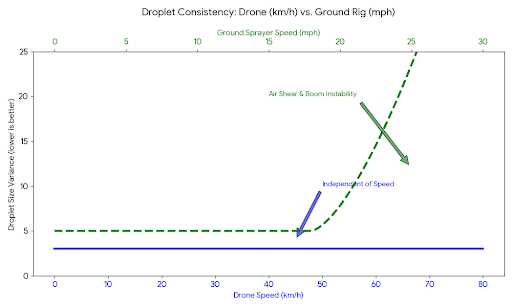
Droplet Consistency

Drone speed vs. ground rig speed impact on droplet uniformity

Ground rigs experience air shear and boom instability above 50 km/h (roughly 30 mph), causing droplet size variance to spike. The T100's centrifugal atomizer produces consistent droplet size independent of flight speed — the blue line stays flat. This means uniform coverage whether the drone is flying at 25 km/h or 72 km/h.

Droplet Size Stability
Click to expand
precision

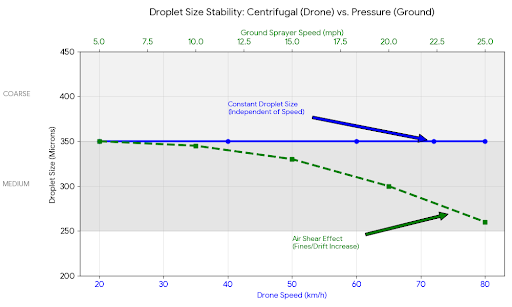
Droplet Size Stability

Centrifugal (drone) vs. pressure (ground) atomization

The T100's centrifugal disc maintains a constant ~350 micron droplet size (medium-coarse range) regardless of speed. Ground sprayers using pressure nozzles see droplet size decrease as speed increases — dropping from medium into the fines range where drift risk climbs. Consistent droplet size means predictable coverage and reduced drift liability.

Swath Consistency
Click to expand
performance

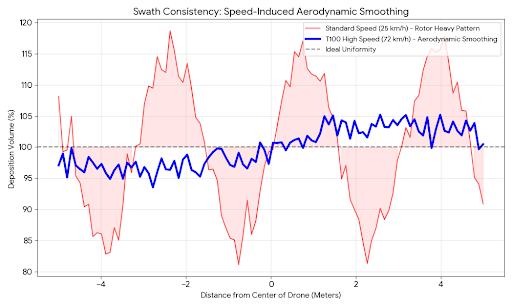
Swath Consistency

Speed-induced aerodynamic smoothing

At standard speed (25 km/h), rotor wash creates a heavy center pattern with significant peaks and valleys in deposition. At the T100's high-speed mode (72 km/h), aerodynamic smoothing flattens the deposition profile to near-ideal uniformity (the blue line hugs 100%). This is one of the T100's most compelling advantages — faster speed actually improves coverage quality.

Operational Speed vs. Efficiency
Click to expand
efficiency

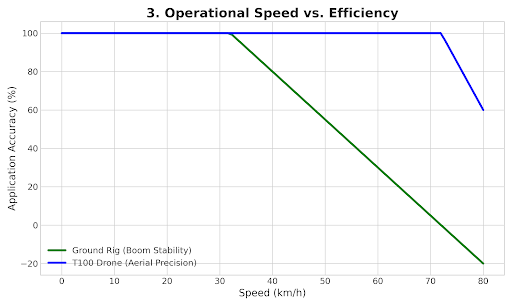
Operational Speed vs. Efficiency

Application accuracy across the speed range

Ground rigs maintain 100% accuracy up to about 30 km/h, then accuracy drops sharply as boom bounce, air shear, and nozzle pressure instability take over — going negative at 80 km/h. The T100 holds 100% accuracy all the way to 72 km/h before any decline. This means the T100 can cover more acres per hour without sacrificing application quality.

The 'Invisible' Yield Drain
Click to expand
economics

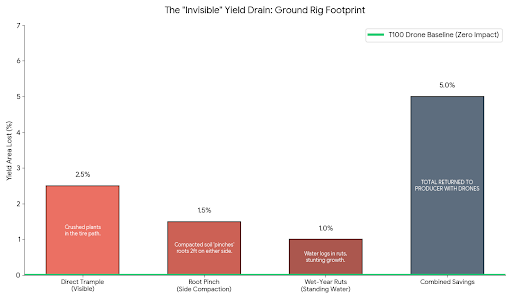
The 'Invisible' Yield Drain

Ground rig footprint — the acres you're losing

Every pass of a ground rig costs yield: 2.5% from direct trampling of plants in tire paths, 1.5% from root pinch and side compaction (6 inches on either side), and 1.0% from wet-year ruts causing standing water. Combined, that's 5.0% yield area lost — returned to the producer with drone application. The T100 baseline is zero impact. On a 1,000-acre operation, that's 50 acres of yield recovered.

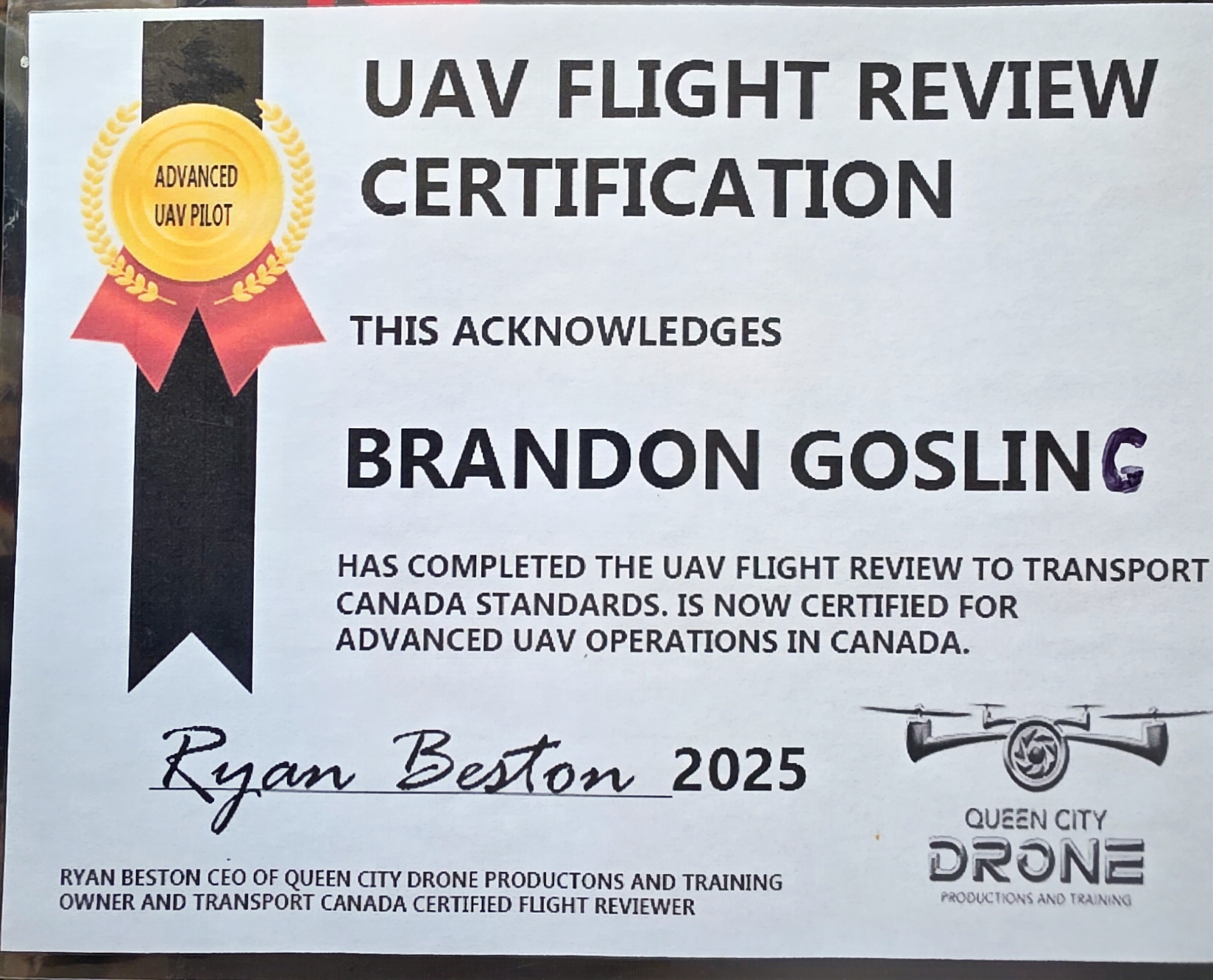
Brandon Gosling — UAV Flight Review Certification, Advanced UAV Pilot, Transport Canada Standards
Prairie Precision Drones — Saskatchewan Business Registration #102220917

PPD #102220917

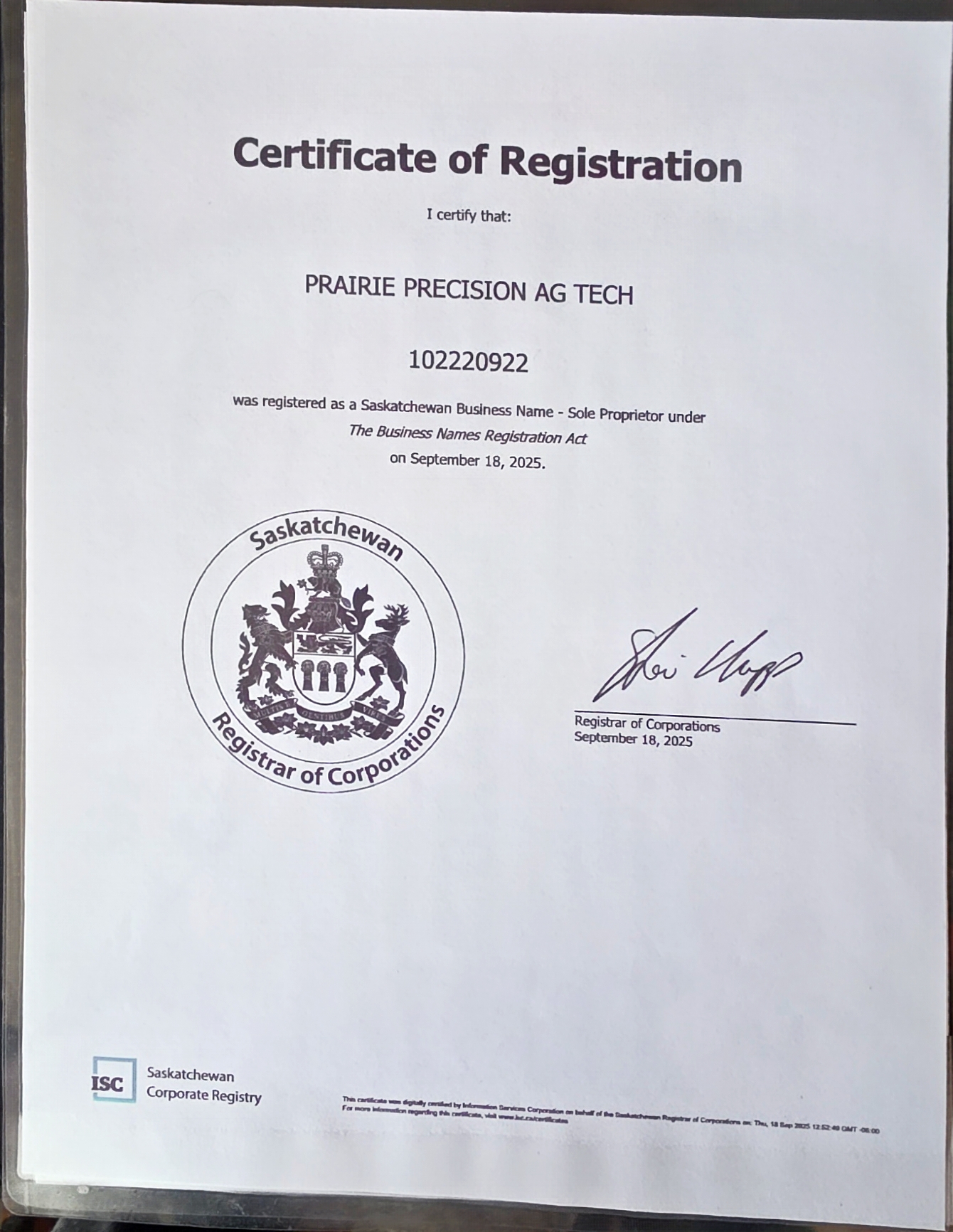
Prairie Precision Ag Tech — Saskatchewan Business Registration #102220922

PPAT #102220922

Certified & Insured

Advanced UAV Pilot — Transport Canada Certified

Brandon Gosling has completed the UAV Flight Review to Transport Canada standards and is certified for Advanced UAV Operations in Canada. Certified through Queen City Drone Productions and Training under Transport Canada Certified Flight Reviewer Ryan Beston.

Transport Canada Advanced RPAS
SK Pesticide Applicator License
$2M Commercial Liability Insurance
PMRA Compliant Operations

Ready to See the Difference on Your Farm?

The data speaks for itself. Let's talk about how drone application can work for your operation this season.